Other popes' attention to Šiluva
Benediktas XVI
Popiežius Šiluvai, Švč. Mergelės Marijos Gimimo šventovei, kurioje Lietuvos žmonės su pasitikėjimu prašo Dangaus pagalbos ir Švč. M. Marijos užtarimo savo medžiaginiuose ir dvasiniuose reikaluose, tėviško dėmesio ženklų yra parodęs ir popiežius Benediktas XVI.
Šio Šventojo Tėvo palaimintomis karūnomis 2006 m. rugsėjį buvo vainikuotas stebuklingasis Švč. M. Marijos su Kūdikiu paveikslas Šiluvos bazilikos didžiajame altoriuje. Popiežius Benediktas XVI artėjant Šiluvos jubiliejui 2008 m. savo ypatingu pasiuntiniu šiose iškilmėse paskyrė kardinolą, Kelno arkivyskupą Joachimą Meisnerį.
„Teisinga, kad garbingojo Brolio Kauno arkivyskupo metropolito Sigito Tamkevičiaus SJ bei kitų Lietuvos vyskupų kvietimu bei raginimu būtų deramai iškilmingai paminėta anksčiau minėto įvykio keturių šimtmečių sukaktis, ypač rugsėjo 13–14 d. Šių iškilmių šventimas suteikia progą ir galimybę ne tik paminėti tą įvykį, bet ir sužadinti širdyse uolesnio tikėjimo dvasią“, – sakė Benediktas XVI savo rašte dėl Šventojo Sosto pasiuntinio Šiluvos Jubiliejuje paskyrimo.
Pranciškus
Popiežiaus Pranciškaus kvietimu 2016 metais švęsti ypatingąjį Gailestingumo jubiliejų tų metų didieji atlaidai Šiluvoje ir buvo skiriami jam paminėti. Jubiliejaus proga 2015 m. gruodžio 13 d. Šiluvos bazilikoje, kaip ir visų pasaulio vyskupijų reikšmingiausiose šventovėse, buvo atvertos Gailestingumo durys. Popiežiaus Pranciškaus palaiminimą švenčiant atlaidus Šiluvoje visiems Lietuvos žmonėms yra perdavęs buvęs apaštališkasis nuncijus arkivyskupas Luigi Bonazzi.
2017-2019 m. Baltijos kraštams paskirtas nuncijus arkivyskupas Pedro López Quintana nesyk pasidalijo džiaugsmu lankytis Šiluvoje, švęsti Švč. Mergelės Marijos atlaidus. 2018 m. atlaidai buvo dvasinio pasirengimo laikas sutikti popiežių Pranciškų, praėjus savaitei po Šilinių apsilankiusį Lietuvoje per savo apaštališkąją kelionę rugsėjo 22–23 d.

Memorials
Kryžius ir nusileidimo aikštė
Popiežiaus Jono Pauliaus II apsilankymui Šiluvoje atminti po metų (1994 m.) ant kalvelės miestelio pakraštyje, pastatytas kryžius.

Pilgrimage House
Šventąjį Tėvą primena ir Šiluvoje įsteigti Jono Pauliaus II namai. 2003 m. rugsėjo 7 d., popiežiaus apsilankymo dešimtmečio proga, arkivyskupas Sigitas Tamkevičius SJ pašventino Jono Pauliaus II namus.

Gatvė
2008 m., švenčiant Švč. M. Marijos apsireiškimo Šiluvoje 400 metų jubiliejų, popiežiaus Jono Pauliaus II vardu buvo pavadinta lygiagrečiai sakralios aikštės einanti miestelio gatvė, ankčiau vadinusis Lyduvėnų g.
Paminklas
Rugsėjo 7 d. minint 15 metų nuo Jono Pauliaus II-ojo viešnagės Šiluvoje, aikštėje tarp Bazilikos ir Apsireiškimo koplyčios atidengtas ir pašventintas jo atminimui skirtas paminklas (autorius – prof. Czesławas Dźwigajus).

John Paul II's homily in Šiluva
Material from the LRT Archive
Homily of Pope Saint John Paul II in Šiluva, September 7, 1993
1. “Let the peace of Christ reign in your hearts!” (Kol 3, 15).
Dear Brothers and Sisters! Today we wish to address to you this greeting of Saint Paul to the Christians of Colossae through the lips of Mary, from this beautiful place—this shrine dedicated to her and so dear to all of Lithuania.
We can all easily understand how deeply a nation longs for true peace—a nation that for so many years endured humiliating oppression, the destruction of its national identity, and a suffocating inhuman ideology.
After the so-called peace of an oppressive regime, there has finally come a peace that promises free and orderly coexistence, respecting all people and their rights.
However, today the Word of God speaks to us of more than mere social peace. It points to that on which social peace depends and by which it is sustained: The peace of Christ!
“Peace I leave with you; my peace I give you” (John 14:27). This is the great gift of the Risen One to his disciples and to all humanity.
The peace brought by Christ is He Himself—His person, His mystery. He truly is “our reconciliation” (Eph 2:14)—our peace. In Him, the hostility born of sin has been destroyed. Through His Incarnation, God and humanity have been united in a definitive covenant of peace and harmony. From His redeeming death flows the gift of the Spirit—the Spirit who comes to unite the scattered children of God, to gather them into one family in the Church, and thus to create a deep and lasting unity among people.
2. “Let the peace of Christ reign in your hearts!”
Dear Brothers and Sisters! This is the peace that the human heart longs for. The new Lithuania is especially in need of it.
I know well how much you have suffered and hoped during those long decades of the iron regime, which only recently came to an end, almost miraculously. I have come here, to Šiluva, to give thanks to God for granting you the strength to overcome those trials.
I greet each one of you. First of all, your Shepherd, the dear Cardinal Vincentas Sladkevičius, and the other leaders of the Church. I greet the priests, religious brothers and sisters, the laity, and all who are devoted to the service of the Gospel.
Together with you, I would also like to honor the many Christians who bore witness to their faith and withstood the grip of harsh persecution. They followed in Mary’s footsteps even to the foot of the Cross. Resisting a materialistic worldview, they turned their gaze toward God. In Jesus of Nazareth, they recognized the Messiah sent by the Father, the Eternal Word made flesh, the Savior and Redeemer of humanity.
We must thank them for their fidelity. The Lithuania of today, now free, owes them a debt for their perseverance and courage.
3. Kristaus ramybė teviešpatauja jūsų širdyse!
Tačiau kokia išties yra toji ramybė, kurią stengiatės užtikrinti savo šalyje? Rasi galima pasitenkinti vien paviršutine taika, kuri tik užtikrina laisvę ir demokratiškumą? Žinoma, šitai, be jokios abejonės, vertinga, bet neatsižvelgia į didžiąsias vertybes, į moralės ir gyvenimo prasmės problemas. Senas tradicijas turinčių demokratinių visuomenių patirtis mus įspėja apie pavojų tokios dviprasmiškos taikos, paremtos minimalizmu ar moraliniu reliatyvizmu.
Štai kur atsiveria nuostabi proga katalikiškajai atsakomybei. Katalikai turi „atsakyti kiekvienam klausiančiam apie juose gyvenančią viltį“ (plg. 1 Pt 3, 15) ir labiau gyvenimu negu žodžiais parodyti, jog taika yra tvirta, kai remiasi tuo, kas aukštybėse, kai ją palaiko moralinės normos ir kai ji atsiveria Dievui. O jei nuklysta į religinio abejingumo ir pragmatizmo pelkę, – bematant sudūžta.
Evangelija, kurią girdėjome per šias pamaldas, aiškių aiškiausiai sako: „Kas klauso šių mano žodžių ir juos vykdo, panašus į išmintingą žmogų, pasistačiusį namą ant uolos“ (Mt 7, 24).
Taip! Kristus tebūna jūsų gyvenimo, jūsų demokratijos ir ateities uola.
4. Brangūs Broliai ir Seserys! Marija, Taikos Karalienė, saugojusi jus ilgais išmėginimų metais, nepaliks vienišų ir ateities kelyje.
Prie Marijos traukiąs pamaldumas, kuris šioje šventovėje toks nuoširdus ir garsus, tepaskatina sekti jos gyvenimu ir tikėjimu.
„Ne kiekvienas, kuris man šaukia: „Viešpatie, Viešpatie!”, įeis į dangaus karalystę, bet tik tas, kuris vykdo mano dangiškojo tėvo valią“ (Mt 7, 21).
Į tokį Viešpaties įspėjimą Marija atsiliepė tobulu paklusnumu. Marija – moteris, kuri ištarė „fiat“ – „tebūnie“. Jinai nesvyruojančio tikėjimo moteris: „laiminga įtikėjusi“ (Lk 1, 45), palaiminta, nes „klausėsi Dievo žodžio ir jo laikėsi“ (plg. Lk 11, 28).
Taigi sekime Ja, tikėjimo keliauninke, visą savo gyvenimą kreipusia tik į Kristų. Jaunystėje Marija, tikra „Siono dukra“, Jo laukia su visa žydų tauta. Per Apreiškimą su neapsakoma meile Jį priima savo įsčiose. Nazarete klauso ir „laiko visus Jo žodžius savo širdyje“ (plg. Lk 2, 51); motinišku rūpesčiu bent iš tolo seka Jėzų viešojo gyvenimo metais. Pagaliau kartu su Juo pasiaukoja ant Kalvarijos, – parodo visa nugalintį tikėjimą.
Bažnyčia žvelgia į Mariją, kurioje mato Motiną ir Pavyzdį. Į Mariją šiuo reikšmingu savo istorijos metu su pasitikėjimu gali žvelgti ir Lietuva. Švenčiausioji Mergelė žino tikruosius ir svarbiausius naujam gyvenimui atgimusios Tautos rūpesčius. Kaip Kanos vestuvių dieną, taip ir dabar ji mus kreipia į Kristų: „Darykite, ką tik jis jums lieps“ (Jn 2, 5).
5. Šventoji Šiluvos Mergele, „Sanitas aegrotorum“ – „Ligonių Sveikata“, su virpuliu šiandien kreipiuosi į Tave kaip Visuotinės Bažnyčios Ganytojas. Slegiančios kančios ir ilgų išbandymų metais Tu nepaliovei žvelgusi į Lietuvą, Kryžių žemę.
Štai atvykstu padėkoti šios tautos tikinčiųjų vardu: per Tavo užtarimą išmušė prisikėlimo ir vilties valanda šioje Tau pašvęstoje žemėje. Kanoje išprašei, kad Tavo Sūnus vandenį paverstų vynu. Padėk lietuvių tautai skausmingą praeities patirtį paversti džiugia ateitimi:
ten, kur buvo persekiojami ir skriaudžiami tikintieji, dabar teįsigali religinė ir visuomeninė taika;
kur vyravo neapykanta, teviešpatauja atlaidumas;
kur siautėjo nepakantumas, dabar visi tesuranda bendrą kalbą ir tarpusavio pasitikėjimą.
Penkiuose Žemynuose pasklidusi Bažnyčia šiandien gerbia Tave, šlovina maloningąjį ir gailestingąjį Dievo planą.
Geroji Motina, visą laiką žvelk į šią tautą ir ją laimink.
Stiprink lietuvių ryžtą klausyti Tavo Sūnaus Jėzaus žodžio; to gyvybės žodžio, kuris čia buvo pasėtas prieš amžius.
Taikos Karaliene, gerbiama Šiluvos Šventovėje, pagelbėk šiems su pasitikėjimu į Tave besikreipiantiems vaikams statyti savo ateities rūmą ne ant pasaulėžiūrų smėlio, bet ant Evangelijos uolos; paskatink visuomeniniame ir politiniame gyvenime vadovautis ne asmeniniu ar kolektyviniu egoizmu, bet meilės ir vienybės idealais.
Šioje žaliuojančių laukų apsuptoje Šventovėje Tu išklausai lietuvių prašymus ir surenki jų viltis. Duok jiems užsidegimo ir drąsos nugalėti materialinius ir moralinius sunkumus; padaryk vaisingus jų rankų ir proto darbus; apsaugok šeimų židinių džiaugsmą, visuomeninio gyvenimo vienybę, palaikyk ateities labui darbuotis pasiryžusią viltį.
Ypatingai Tau pavedu jaunimą: Kristuje jie teatranda savo gyvenimo prasmę ir išsaugo budrią viltį.
Tau pavedu Vyskupus, Kunigus, Dievui pasišventusius žmones ir visus krikščionis. Išprašyk kiekvienam malonės ištvermingai ir kilniadvasiškai tarnauti Dievo Karalystei, tarp savo brolių tapti naujosios evangelizacijos raugu.
Marija, visų lietuvių Motina, šios Tavęs besišaukiančios ir Tave mylinčios Tautos „Žvaigžde“, melski už mus!
Visos Popiežiaus Jono Pauliaus II kalbos Lietuvoje >>
St. John Paul II and Šiluva
The visit of st. John Paul II to Šiluva
On September 7, 1993, on the eve of the Feast of the Nativity of the Blessed Virgin Mary, Pope Saint John Paul II visited Šiluva. The Holy Father had more than once mentioned in his addresses that he dreamed of praying before the image of Our Lady of the Gate of Dawn and of honoring the renowned Virgin of Šiluva – Health of the Sick.
On the fourth day of his visit to Lithuania, the Holy Father arrived in Šiluva by helicopter from Hill of Crosses. A special landing site had been prepared for this occasion on the edge of the town, by the road to Raseiniai. Today, the spot is marked by a large wooden cross erected on a small hill.
He then traveled by popemobile along the town’s side streets, passing residents’ homes and the cemetery on his way to the Apparition Chapel. After stepping out of the popemobile, he went to greet the people—rather than proceeding directly to the chapel as planned—which posed a significant challenge for security.


At the chapel, he met with Prelate E. Simaška. Inside the chapel, he knelt in prayer and kissed the stone of the apparition of the Blessed Virgin Mary.
He then took part in the Liturgy of the Word in the basilica, dedicated to the theme “The Christian Family.” pamokslo įrašą išsagojo LRT >>.
At the end of the celebration, at the request of Cardinal Vincentas Sladkevičius, he personally crowned the statue of the Immaculate Heart of Mary—brought from the United States and having visited many Lithuanian diaspora parishes—entrusting the Lithuanian nation to the care of the Blessed Virgin Mary.


The Pope’s visit to Šiluva is commemorated by a golden rosary crafted by Vatican artisans and donated by him, which is now kept in the Šiluva Museum.

Pope Saint John Paul II asked the Virgin of Šiluva to strengthen the resolve of the Lithuanian people to listen to the word of Jesus—the Word of Life that was sown here centuries ago. The Holy Father assured the faithful that Mary, the Queen of Peace, who has protected Lithuania for centuries, will not abandon it in the future. At the same time, he urged them to follow her example as a “pilgrim of faith”: to direct their entire lives toward Christ, to listen to the Word of God, and to live by it.
Full text of the Holy Father’s homily >>.
Addressing the Pope and the gathered faithful, Cardinal Vincentas Sladkevičius emphasized the importance of devotion to Mary and pilgrimages to Šiluva in the Lithuanian nation’s journey toward freedom:
“A very eloquent sign given to us by Providence is that the rebirth of conscience and of society, and the beginning of liberation, are closely linked precisely with the revival of Eucharistic adoration and devotion to Mary. In the 1970s and 1980s, penitential and prayer pilgrimages of Catholics—mostly young people—to Šiluva, the communal praying of the Holy Rosary, and the spirit of reparation for the sins of the nation—as the true path to inner freedom—helped to shape the self-awareness of the Church in Lithuania and encouraged the activity and responsibility of the laity in the spirit of the Second Vatican Council.”
Events of the last century
Events of the last century
7 September 1993 Pope St. John Paul II visited Šiluva. The Holy Father prayed in the Chapel of the Apparition of the Blessed Virgin Mary and took part in the Liturgy of the Word in the Basilica of the Nativity of the Blessed Virgin Mary.


The Pope, as if echoing the message that the Virgin Mary conveyed to the shepherd children during the apparition, said that Mary directed her whole life toward Christ. She invites us to do the same: “Do whatever He tells you” (Jn 2:5). “In Cana, you asked your Son to turn water into wine. Help the Lithuanian nation to transform the painful experience of the past into a joyful future,” the Holy Father prayed in Šiluva.
2003 after restoration, the miraculous image of the Blessed Virgin Mary with the Child was returned to the high altar of the Šiluva Basilica; in 2006, it was crowned with crowns blessed by Pope Benedict XVI.

2003during the Šilinės indulgence feast, marking the tenth anniversary of the Holy Father’s visit, Archbishop Sigitas Tamkevičius SJ blessed the John Paul II House, which today serves the spiritual formation of priests and other faithful, hosts retreats and seminars for various Lithuanian communities and individuals, and accommodates pilgrims.

2008 during the celebration in Šiluva of the 400th anniversary of the apparition of the Blessed Virgin Mary, a monument to Pope John Paul II was unveiled in the sacred square to commemorate the 15th anniversary of his visit to Lithuania (sculptor: Prof. Czesław Dźwigaj of the Kraków Academy of Fine Arts); at the same time, the street next to the square was named after the Pope.

2007 the parish of Šiluva marked the 550th anniversary of its establishment.
6–15 September 2008 during the solemn celebration of the 400th anniversary of the apparition of the Blessed Virgin Mary, Šiluva was visited by the envoy of the Holy Father Benedict XVI, Cardinal Joachim Meisner, Archbishop of Cologne.
During the ten days of the Jubilee, up to 150,000 pilgrims visited Šiluva—not only from Lithuania, but also from nearby and more distant countries of Europe and America, from Australia, and individually from Asia and Africa. It was precisely at that time that the name of Šiluva spread widely throughout the world: news agencies reported on the apparition of Mary and the shrine of Šiluva. For the first time in the history of Šiluva—once marked by confessional tensions—ecumenical services were held, attended by representatives of several Christian Churches and communities.
In preparation for the Jubilee, through the care and initiative of Kaunas Archbishop S. Tamkevičius, and with the support of the Kaunas Archdiocese community, various sponsors, and donors, a pre-war plan was realized to connect the Šiluva Basilica with the Chapel of the Apparition by creating a sacred space.
In the renovated square, in addition to the already mentioned memorial to St. John Paul II, a restored statue of the Blessed Virgin Mary was erected—a precise bronze replica of the earlier one. A Pilgrim Information Centre was built, and the Šiluva History Museum was opened within it. On both sides of the square, artistic roadside shrines of the Rosary were installed for prayer. The Basilica and the Chapel of the Apparition have been gradually restored, and the white 44-meter-high tower of the chapel continues to greet pilgrims approaching Šiluva even today from afar.
2009 by decree of Kaunas Archbishop S. Tamkevičius, Days of the Sick are held in Šiluva on the last Friday of each month.
9 April 2009 by decree of the Metropolitan Archbishop of Kaunas, Sigitas Tamkevičius, in response to the sincere devotion of the faithful and with the aim of more widely spreading the message of the apparition of the Blessed Virgin Mary in Šiluva, the Society of the Blessed Virgin Mary of Šiluva was established.
2011 The Šilinės indulgence feast began to be celebrated from 7 September (previously it had started on 8 September) and continues, as usual, until 15 September. From then on, the first day of Šilinės has always been dedicated to Pope St. John Paul II, who visited Šiluva on 7 September 1993.
2013 A Pilgrim Path with 14 Stations of the Cross was also established and blessed on 25 August. It is a route of approximately 2 km through the Šiluva pine forest, leading to the Chapel of the Apparition.
2016 on the occasion of the Extraordinary Jubilee of Mercy, the Holy Doors of Mercy were opened in the Šiluva Basilica.

Occupation and Independence
The period of Tsarist rule
The authorities of Tsarist Russia prohibited pilgrim processions to Šiluva and did not allow priests to travel there without special permission. Nevertheless, despite these restrictions, the centenary of the coronation of the image of Mary was solemnly celebrated in 1886, with the participation of several tens of thousands of pilgrims.
The Tsarist authorities had planned to build an Orthodox church in the town square of Šiluva, opposite the church, but the parish priest hurried to purchase the square. There he erected a statue of the Blessed Virgin Mary.
During the years of the press ban, Šiluva became something of a center for the distribution of Lithuanian books, from which various publications reached even the most remote corners of Lithuania. Up to 200 book smugglers and scapular sellers would gather at the indulgence feast, while around 300 Russian police officers would arrive to catch them, as well as pilgrims who used banned prayer books. Nevertheless, they rarely succeeded in apprehending a book smuggler.
After the restoration of independence, Šiluva experienced an even greater revival. From 1933, religious congresses began to be organized during the Šiluva indulgence feast—such as those of the Apostolate of Prayer for men, Catholic men’s groups, and women’s organizations. Schools and gymnasium classes also organized their own pilgrimages. From the beginning of the 20th century, cultural events were also organized in Šiluva, including films and theatrical performances. In Kaunas, a committee operated to organize pilgrimages to Šiluva.

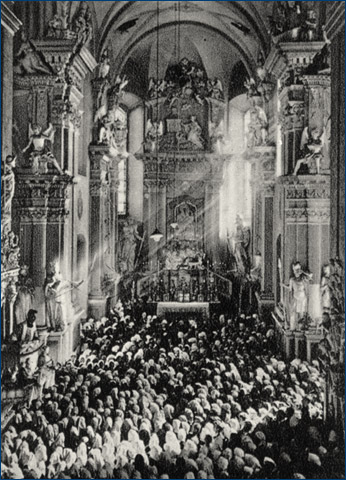


There was never a shortage of pilgrims during the Šilinės indulgence feast. They came from various parts of Lithuania. Among them were the blind, the deaf, the mute, the lame, and those suffering from other illnesses. Pilgrims walked the Stations of the Cross, prayed before the grace-filled image of the Mother of God, and sought God’s help. Šiluva was also known for beggars, who sought to attract the attention of pilgrims with their poor appearance, hymns, and lamentations.
The Soviet period
During the Soviet period, Šiluva—long renowned throughout all times—was deliberately neglected and diminished by the authorities. In an effort to drive out the spirit of devotion, a monument “to those from Šiluva who died for Soviet rule” was erected in the town square opposite the church, replacing the statue of Mary.
The Soviet authorities made every effort to disperse or at least intimidate the pilgrims traveling to the indulgence feast. From the 1960s onward, the militia was used to obstruct their arrival—some drivers had their licenses confiscated, passengers were forced to disembark, and similar measures were taken. Roads and even side paths leading to the town were blocked. In 1979, an outbreak of swine fever was even declared in order to prevent pilgrims from coming.
However, on the last Sunday of August, young people—especially members of the Friends of the Eucharist—would still travel in procession from Tytuvėnai to Šiluva. The Chronicle of the Catholic Church in Lithuania records the third march to Šiluva, organized by the Friends of the Eucharist on 21 August 1977:
“The militia and security officers were guarding the forest where we had been gathering for the common journey since 5 a.m. Militia vehicles stood watch at every road leading to Šiluva and suspiciously checked passing cars, forcing passengers to disembark by the roadside and confiscating some drivers’ licenses. The militia recorded the license plate numbers of private cars and checked the documents of their owners. Many had to hurry a considerable distance on foot to reach the agreed meeting place. But the people, filled with enthusiasm and courage, did not lose heart. At the meeting place, in the small forest, a cross was erected, which the youth adorned with a wreath of Lithuanian rue, and, gathering around it in a circle, they loudly prayed the Rosary.”

That people did not yield to intimidation is also evident in another article of the Chronicle of the Catholic Church in Lithuania (LKBK, No. 12, 1974)
“At the beginning of September, during the Šilinės indulgence feast, crowds of thousands of people streamed to Šiluva. On Sundays, cars could not fit into the town, and traffic inspectors directed them to park in the fields. The inspectors demonstratively recorded the license plate numbers of the vehicles. During the Šilinės indulgence feast, around 50,000 Holy Communions were distributed each year.”
The Chronicle provides statistical data on the number of participants in the processions to Šiluva: in 1975, 500–600 people took part; in 1976, 600–700; and in 1977, 800–1,000. Considering how the Soviet authorities sought to disperse any religious gathering, these processions indeed drew large numbers of people who, overcoming fear and various obstacles, chose to participate.
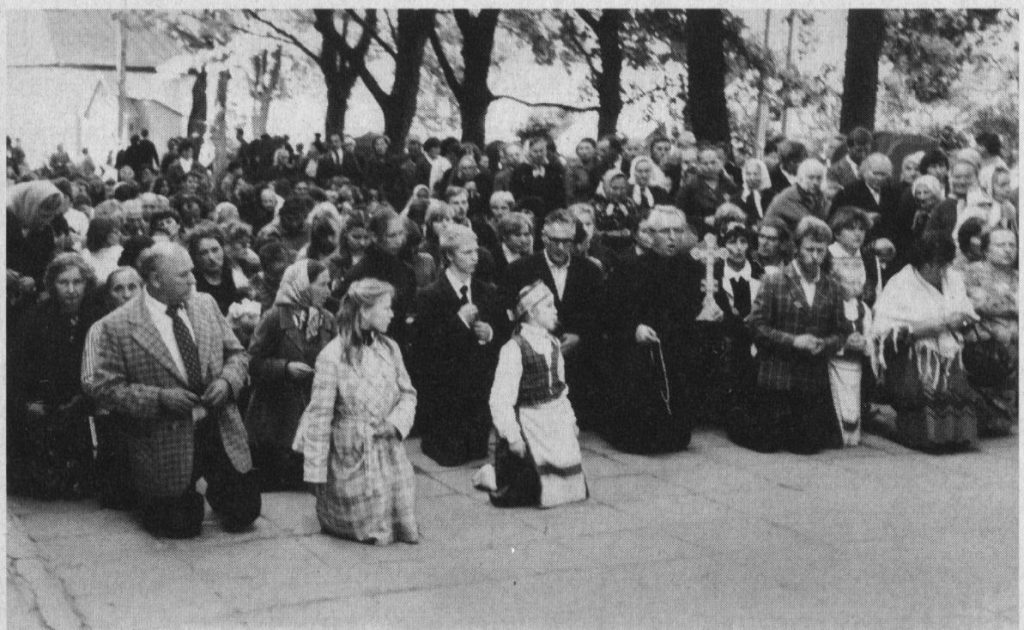

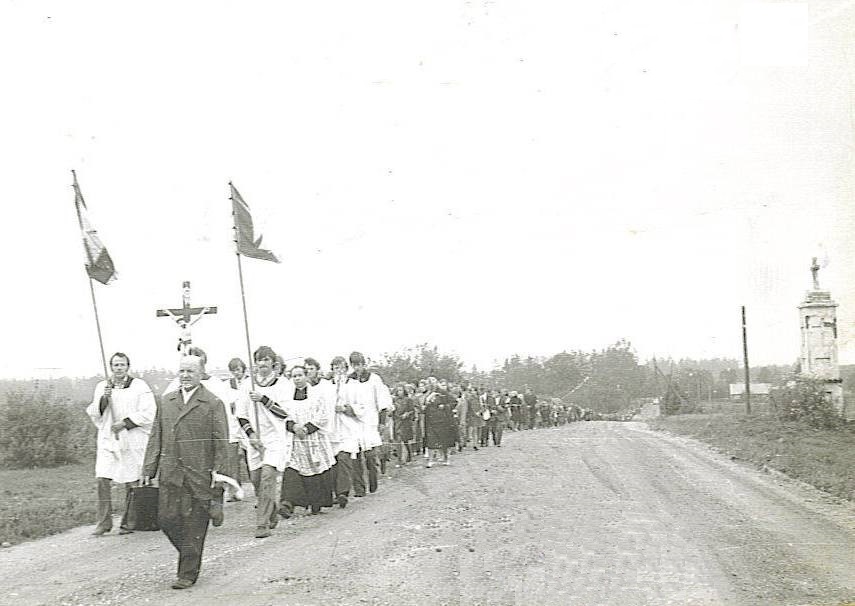

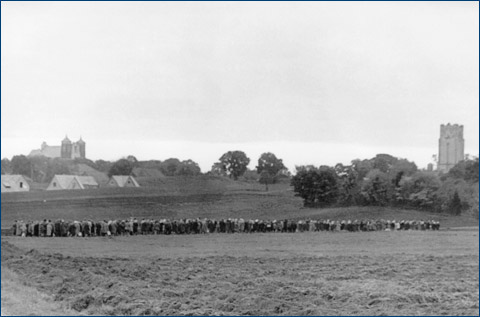
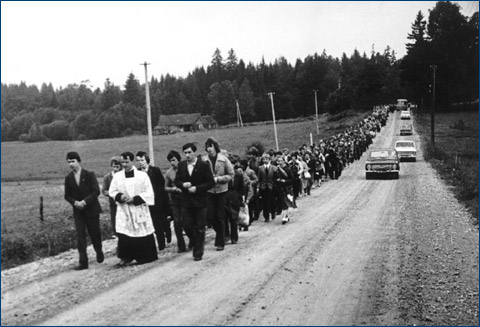
Organizers of devotional journeys were especially persecuted. Sister Gema Stanelytė of the Congregation of Eucharistic Jesus and Vytautas Vaičiūnas were sentenced to three years of imprisonment for organizing processions to Šiluva.
However, despite all the efforts of the occupying authorities, Šiluva remained a witness to the spiritual strength of the Church—a place where the Lord is worshipped and where strength for both soul and body is drawn.
In exile
Lithuanians living in the free world also did not forget the Šiluva indulgence feast.
The first Šilinės celebration took place on 8 September 1947 in Altötting, Bavaria; another was held on 16 November 1947 in Absam, Tyrol, Austria.
The Šilinės indulgence feast was celebrated in Lithuanian parishes in Argentina, Uruguay, and the United States. From 1959 onward, Lithuanian pilgrim processions were also held in Chicago and Marianapolis. From 1957, the Federation of American Lithuanian Affairs Councils, with the support of American bishops, organized a Day of Prayer in Lithuanian parishes on the occasion of Šilinės—a spiritual pilgrimage to Šiluva.
Independent Lithuania
After Lithuania regained independence, the Nativity of the Blessed Virgin Mary indulgence feast in Šiluva became one of the most important events in the religious life of Lithuania. It was actively promoted, and booklets and brochures about Šiluva were published.
On 8 September 1991, in Šiluva, giving thanks to God for the gift of freedom and in the presence of all the bishops of Lithuania, Cardinal Vincentas Sladkevičius consecrated Lithuania to the protection of the Blessed Virgin Mary. The act of consecration is preserved here. This act signified that the hopes and expectations of independence were entrusted into the hands of the Mother of God of Šiluva, who had continually accompanied the nation on its path to freedom through her intercession.
The Soviet occupation did not succeed in uprooting the tradition of pilgrimages to Šiluva. On the contrary, the processions—banned, obstructed, and persecuted by the authorities—strengthened people’s devotion, especially among the youth, fostering unity and determination to remain faithful to their beliefs.
Organized pilgrimages to the Šiluva indulgence feast continued, not only from nearby parishes but also from Kaunas. Up to 100,000 pilgrims would gather for the Šiluva indulgence feast. A committee for organizing pilgrim journeys was even established in Kaunas.
A new impetus, filled with hope in turning to the Mother of God of Šiluva, was given to the Lithuanian nation by the visit of Pope John Paul II to Šiluva on 7 September 1993.
For the people of Lithuania building an independent life—and amid the conditions of freedom that brought their own challenges and difficulties—Šiluva has remained a visited and cherished modern pilgrimage shrine.
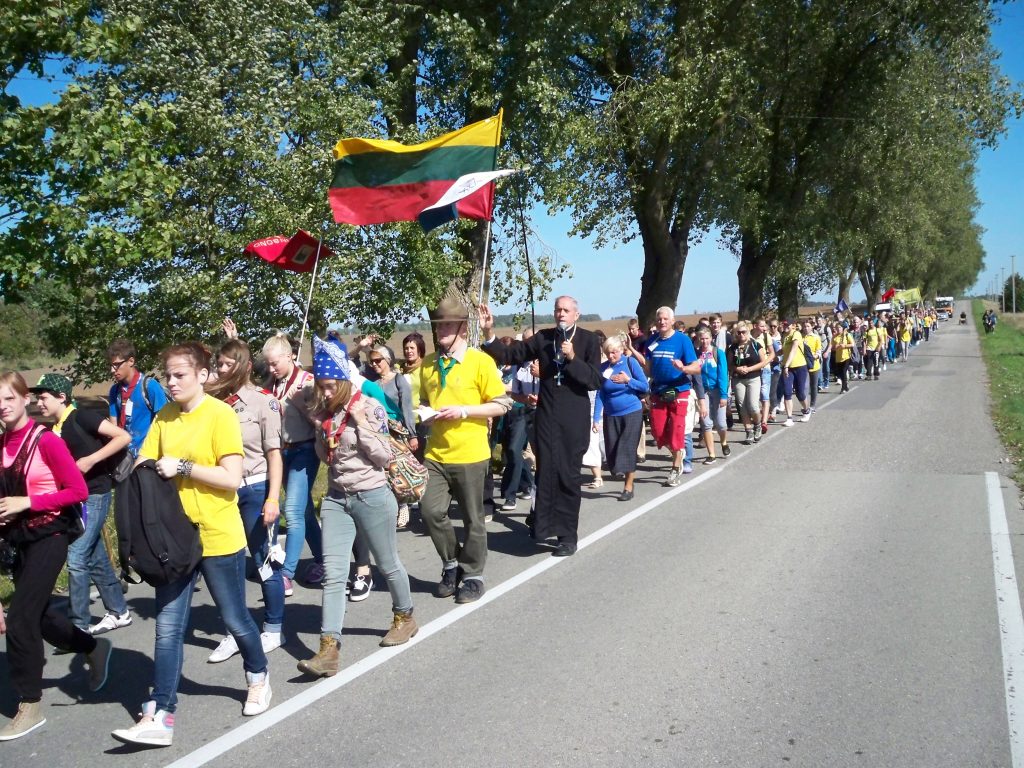
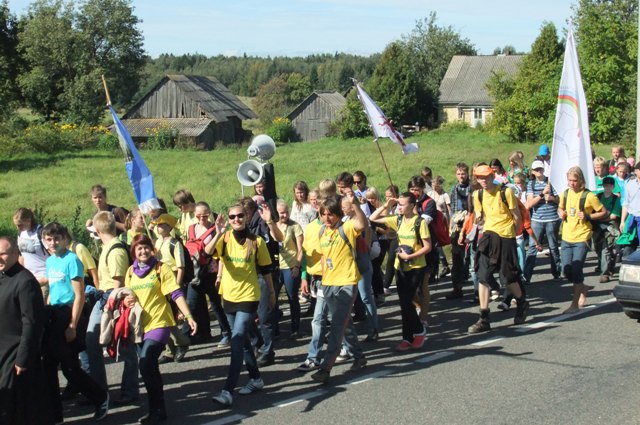
Each year at the beginning of September, pilgrims from all over Lithuania, together with visitors from abroad, gather in great numbers in Šiluva to celebrate the Šilinės indulgence feast, which lasts for a full octave. Its tradition—restricted in various ways during all periods of occupation—has remained alive: it can be said that the great Nativity of the Blessed Virgin Mary indulgence feast in Šiluva has been celebrated for nearly five hundred years.
The Revival of Šiluva
The restoration of the church
After the Catholics regained the church lands in Šiluva (in 1622), Fr. Jonas Smolka-Kazakevičius became the parish priest.
In 1623–1624, after a small wooden church had been built, the Šilinės indulgence feast began to be celebrated in Šiluva once again.
The Catholics had to expend considerable effort to recover the confiscated church property, and as a strong wave of the Reformation was sweeping across Lithuania, it was likely not expected that the small church would soon become too cramped.
For, as noted by the first historian of Šiluva, M. Svietkauskas, people began to travel in great numbers, in groups, to the feast of the Blessed Virgin. Crowds flocked to the revived indulgence celebrations. In 1629, 11,000 communicants were distributed during the days of the indulgence feast.
Therefore, the following year Kazakevičius began the construction of a new church. Like the first, it was built of wood, but it was much larger and more ornate, in the then-popular cruciform church style. This style or form was characteristic of the period of restoration, emphasizing the significance of the Cross. The church was completed in 1641.

The construction of the brick church
In the mid-18th century, two indulgence feasts in Šiluva were especially renowned—the Nativity of the Blessed Virgin Mary, celebrated on September 8, and the Visitation of the Blessed Virgin Mary, celebrated on July 2, which was also well known in Žemaičių Kalvarija. Bishop Antanas Tiškevičius, in his report to Rome, wrote that on these occasions people came to Šiluva not only from all over Samogitia but even from Vilnius and other nearby dioceses, wishing to pray before the renowned image.
Therefore, in 1760, the construction of the brick church in Šiluva was begun.
On 22 October 1774, Bishop Jonas Lopacinskis forwarded to Rome a request by Canon Tadas Bukota to grant permission to crown the image of the Virgin Mary with the Child, “renowned from ancient times for special graces and miracles.”
In 1775, permission to crown the image of Mary was received from the Chapter of Rome. However, the coronation of the image was postponed until 1786, likely in the hope of consecrating the new church on the same occasion. In addition, with the permission of Pope Pius VI, the Nativity of the Blessed Virgin Mary indulgence feast began to be celebrated throughout an octave—from 8 to 15 September.
On 15 September of the same year, by a papal bull, Pope Pius VI granted the church of Šiluva the title of an infulated provostship. From that time on, the parish priests of Šiluva, as infulated prelates, were permitted during liturgical services to wear a mitre, a ring, to use a pastoral staff, and other episcopal insignia.
On 8 September 1786, the new masonry Catholic church—the present Basilica of the Nativity of the Blessed Virgin Mary—was consecrated. It was consecrated by Tadas Juozapas Bukota, who had become the suffragan bishop of Samogitia (assistant to the bishop).
The coronation of the image
The coronation ceremonies of the image of the Blessed Virgin Mary with the Child, which began on 8 September 1786, lasted for three days. Around thirty thousand people gathered for the celebration, including three senators, many nobles, and high-ranking state officials even from Poland. According to some sources, five bishops took part in the ceremonies; according to others, as many as twelve.
The image was crowned by the Bishop of Samogitia, Prince Steponas Jonas Giedraitis. On this occasion, in a letter he wrote, he joyfully urged: Salutate Mariam, quae multum laboravit in vobis (“Greet Mary, who has done so much for you.”)
The faithful, it seems, readily responded to this exhortation of the bishop. No occupying authority could stop the pilgrims flocking to the indulgence feast.
People were drawn to Šiluva not only by the indulgence feast itself, but also by the ever more widely spreading news of the apparition of Mary in Šiluva and by the image of the Blessed Virgin Mary with the Child hanging in the church, renowned for its graces since 1622.
Processions
Already from the 17th century, people were accustomed to going to Šiluva in groups, travelling in processions. A 1677 report by the Jesuits to Rome, addressed to the Superior General of the order, describes the custom of the students of the Kražiai College to undertake an organized devotional pilgrimage to Šiluva each year. The Jesuit college operating in Kražiai since 1616 had chosen the Mother of God of Šiluva as its patroness. Therefore, at the end of the academic year, the students of the college would all go together to Šiluva to give thanks to the Mother of God.
Pilgrims travelling in an organized manner to the indulgence feasts would pray and sing along the way, carrying crosses, church banners, small altars, beating drums, and playing horns. Such processions were usually led by the parish priest, dressed in liturgical vestments. They are already mentioned at the end of the 17th century by the parish priest of Šiluva, J. Skirmantas.
The organized travel of pilgrims to the indulgence feasts and the processions were encouraged by Bishops Merkelis Giedraitis and Merkelis Geišas. To prevent processions from becoming overcrowded at the same time, Bishop Antanas Tiškevičius in 1752 assigned separate days and a travel order for the parishes. The people willingly obeyed the guidance of their shepherds. For during the journey in groups to the indulgence feasts and in the processions, they not only prayed but also witnessed impressive sights. Even hired workers, when negotiating their yearly wages, would secure a few days off in order to visit the famous indulgence feast. Bishop Motiejus Valančius, in The Diocese of Samogitia, wrote—without sparing vivid words:
“Upon entering the town, the young men waved banners, beat drums, blew trumpets, and fired guns, while the elders together with the women sang and called out with fervor; for the parish that entered the town with the greatest commotion and display was considered the most honorable.”
In the time of Bishop M. Valančius, banners were carried by young men on horseback. Hymns were accompanied by drums or horns. In addition to the usual banners, girls in the procession carried small flags that formed a wreath symbolizing the rosary. At the boundaries of the parish stood ceremonial gates, decorated with wreaths, banners, and inscriptions. Travelling pilgrims were greeted there by a local procession with a cross, two banners, and a leading priest. The processions would greet one another, the banners would bow, and the priests of both the arriving and the welcoming groups would deliver a short address, after which the pilgrims, together with those who had come to meet them, would proceed to the local church to honor God. During the indulgence feast, the parish priest took care of the pilgrims of his parish. After spending the prescribed time at the feast, the pilgrims would return home together. Back home, they would share their impressions with family and neighbors, and the entire parish would long live in the spirit of the indulgence celebrations.
Travelling in processions to the indulgence feasts not only fostered people’s devotion and religious fervor but also had certain drawbacks. Bishop Motiejus Valančius wrote:
“There is no work so pious that people would not turn it to ill. The same happened with holy pilgrimages. People, especially those from more distant parishes such as Kalvarija or Šiluva, unable to reach the destination in a single day, almost always spent the night at taverns; staying overnight in groups in the forests, they would sometimes become drunk and commit other misdeeds. Young men, seeking greater commotion, even dared to fire guns inside churches. Having witnessed all this, Bishop Jonas Lopacinskis in 1763 strictly forbade travelling to the indulgence feasts in such a manner.”
Other bishops also no longer encouraged travelling in processions, although some parishes continued to do so on their own initiative. It was also considered problematic to leave a parish without a priest, which often happened when the priest departed with the pilgrims to the indulgence feast.
After 1866, when the centenary of the coronation of the miraculous image was commemorated during the indulgence feast—attended by the Bishop of Samogitia, M. Paliulionis, 40 priests, and 40,000 pilgrims—the occupying Tsarist authorities banned all processions, and this prohibition remained in force until 1905.
The first organized parish processions to the Šiluva indulgence feast resumed in 1906. They drew 50,000 pilgrims. The pilgrim journey to Šiluva in 1906 was described by Žemaitė in "Journey to Šidlava".
“This year has turned out in such a way: priests, leading their parishes, go on foot to the miraculous places—to Žemaičių Kalvarija, to the Great Calvary indulgence feast, to Šidlava, to the Šilinės. People prepare and set out from their homes in groups upon groups, with all the church items, with full solemnity. Well then, may God grant them health! I too will go to Šidlava.
The day dawned sunny, clear, and warm as in the height of summer. From early morning, already prepared, I kept looking toward the road to Kelmė.
“Towards noon I saw from afar—a wave, a shimmering multitude of people approaching; the main road, perhaps half a verst long, was alive and flickering with people. Already the hymns could be heard, they were drawing nearer, and all the splendor became visible; the banners moved along, rattling, a cross adorned with a wreath, lanterns, small white flags, a banner woven of wreaths—the Name of Mary—carried by two men on two poles. These were all borne by men. Behind them, four girls carried a small altar. Four others carried palms, while six, having woven a great wreath—perhaps two fathoms in length—surrounded the parish priest. The priest stood within this wreath, wearing a St. John’s cap, leaning on a staff, moving along like an old man. The beadles, the elders, with rattling staffs, kept order around the priest, clearing the way. A group of singers, walking together with the priest, sang the Litany; further on, another group sang the Hours; further still, a group prayed the Rosary. And so, in groups, along the same road, each sang something different.”
The Reformation Period
The Reformation reaches Šiluva
In the 16th century, the wave of the Reformation reached Šiluva. Around 1532, its owner, Jonas Zaviša, together with other nobles, converted to the Reformed faith. About one and a half kilometres from the town, he built a Protestant chapel, which was later renovated or expanded. In 1555, Jonas Zaviša transferred Šiluva to his brother Merkelis, who is regarded as the founder of the Calvinist parish in Šiluva.
For a time, both an Evangelical Reformed chapel and a Catholic church functioned in Šiluva. However, in 1560, when Šiluva came under the control of Merkelis Zaviša’s cousin, Merkelis Šemeta—an especially zealous promoter of the Reformation—the property of the Catholic church in Šiluva was confiscated, and the church itself was closed.
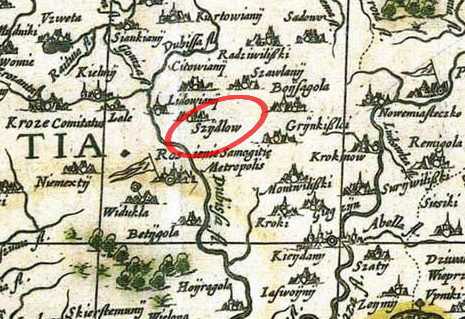
The new Reformed centre established on the estate’s land gradually came to be known as Zbarai., nes zbarais The term zbor (in Polish) was used to refer to Calvinist communities and their houses of worship. The town of Šiluva began to decline into a village, while the locality of Zbarai—referred to in official documents as Šiluva (Szydlowa)—was becoming a cultural centre for the entire Calvinist region of Samogitia. The Catholic population was increasingly pressured to convert to the new confession.
Around 1569, the last parish priest of Šiluva, Jonas Holubka—perhaps foreseeing the destruction of the Catholic church—gathered the remaining church valuables and documents and, placing them in an iron-bound chest, buried them near the former church.
The activity of the Calvinist Sofija Vnučkienė
The resourceful and particularly devoted Calvinist Sofija Vnučkienė, the widow of Morkus Vnučka, in 1591 arranged to purchase the confiscated parish lands from the then rulers of Šiluva and transferred them to the Calvinist community.
The purchase agreement was signed on 1 September 1591 and stated that the Šiluva estate was being transferred “together with the town and its church dependents, with the rectory and the Pašakarnis manor belonging to the Šiluva parish.” For this, she paid 9,000 Polish złotys to Merkelis Zaviša.
Three months later (on 4 January 1592), she “transferred, donated, and granted Šiluva with its estate, town, and the Pašakarnis manor belonging to the Šiluva property, together with the church and church buildings, as well as all the land and its dependents” to the Calvinists of Šiluva.
In one of her writings, S. Vnučkienė states: “With great dedication I took care to redeem this place, (for) some decades earlier it had been cleansed of Roman idolatry and adorned (by the Reformed).” However The enemies of God took particular care that it should return to its former state.” The greatest threat was the owner’s own son, Andrius Zaviša, who had already returned to Catholicism. His father was already old and could die at any moment (in fact, he died a year later), and once the son took over, he would undoubtedly have restored Šiluva to its “former state.”
According to her intentions, this could not be allowed, so she devoted all her efforts to making Šiluva a centre of Calvinism. More than other Reformed nobles, she sought not to leave the people in “idolatry”—she ensured that Calvinism was proclaimed in the Lithuanian language and published the first Calvinist Gospels in Lithuanian. She also made significant efforts in establishing a Calvinist parish school. “Children of the common people” were admitted there—even if they were not Evangelicals—but in return they were required to attend Calvinist services. In 1592, a Calvinist seminary was established in Zbarai—the only school in Lithuania dedicated to training their clergy and teachers.
After several years, a masonry church was built in place of the wooden Calvinist chapel that had stood there (construction began in 1593 and was completed in 1595). It is believed that bricks and stones from the former Catholic church were used for this new building, and a bell from the Catholic church was also transferred to the new Calvinist church, where it rang for many years, bearing the inscription: O florens Rosa, Mater Dei speciosa! (“O blooming rose, pure Mother of God!”). The golden and silver vessels of the Catholic church and other liturgical items were destroyed, as well as church vestments and furnishings. With the demolition of the Catholic church, the “cleansing” of Šiluva from “Roman idolatry” was meant to be completed.
The recovery of the Šiluva church
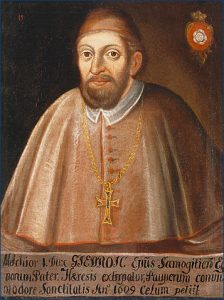
It is true that the rise of Calvinism was opposed by the Bishop of Samogitia, Merkelis Giedraitis, who initiated legal cases to recover the lost churches, as the Third Statute of Lithuania (1588) recognized the right of Catholics to reclaim confiscated property.
Around 1606, the bishop entrusted the work he had begun to a devoted priest—his friend and collaborator, Jonas Smolka-Kazakevičius. He showed great courage by initiating the case of Kelmė and, on 11 August 1609, succeeded in restoring the church of Kelmė to the Catholics. The case was difficult, as the property documents had been lost; however, it was remembered to whom they had been entrusted, and the bishop together with his curia were aware of the church’s property. This, however, was only preparation for the case of Šiluva, since no information at all was available about the founding documents of Šiluva.
It was possible to rely only on Vnučkienė’s writings, which stated that this place had long been reformed and cleansed of “Roman idolatry,” and on that basis to initiate the case; however, it was difficult to define the claim. Without the necessary documents, there was no hope of winning the case.
At this point, the Blessed Virgin Mary herself enters this difficult and complex history. After her apparition (which took place in 1608), the church’s foundation documents were unexpectedly discovered in 1612. Once they were found, the case continued without interruption from 1612 and was won after ten years. Written accounts of Šiluva’s history state that “the case lasted more than 15 years,” which suggests that the first unsuccessful proceedings may have begun in 1607 or 1608. The case was finally concluded on 22 July 1622 by the decision of the Vilnius Tribunal.
Further disputes
However, the Calvinists did not rush to implement the decision. The Catholics then attempted to take possession of the lands awarded to them on their own, but encountered resistance from the Calvinists. A month after the tribunal’s ruling, clashes broke out between the two sides in the church gardens.
Another widely known uprising occurred when the new parish priest of Šiluva, Sviekauskas, attempted on his own initiative to reclaim a disputed plot of land from the local Calvinists. This land was located by a large stone, near the newly rebuilt chapel of Bishop A. Sapiega. The Catholic cemetery was also situated there. Having conceived this plan, Canon Sviekauskas sent his vicar, Fr. Sierniauskas, together with Mr. Simanavičius and a group of men to take back the mentioned land.
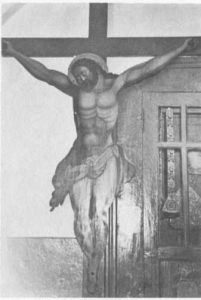
At that time, the Calvinist pastor was Chelkauskas. The new pastor gathered people, armed them, and ordered them to drive away the men of Sviekauskas. When the two sides met, they began to argue, then to fight with fists and sticks, and finally, as they approached the chapel, they started shooting. One bullet struck and wounded Fr. Sierniauskas, while another pierced the image of the Crucified hanging in the chapel, which had been donated by Bishop Sapiega. This took place at the end of 1668 or the beginning of 1669.
In Šiluva, this was not the first such incident—the struggle against crosses as signs of “Roman idolatry” also took place elsewhere in Lithuania. A well-known case occurred in 1640 in Vilnius, in which Calvinists were accused of shooting at sacred images in St. Michael’s Church and at a cross on top of the church.
The case in the Parliament of the Republic of Lithuania
Bishop Kazimieras Pacas, having investigated the incident and gathered evidence, decided to bring a case against the Calvinists of Šiluva before the State Seimas itself. The conduct of the Calvinists of Šiluva, as it was presented to the Seimas, provoked considerable outrage among both the assembled nobility and the new king, Kaributas Wiśniowiecki. Such behavior, violating the majesty of God, was strictly punished under the laws of the state.
The following penalties were imposed on the Calvinists of Šiluva: their community was dissolved, their lands were confiscated, and three “zbor members” along with a preacher were sentenced to death. The royal decree of the Seimas was signed on 6 November 1669 in Kraków.
Efforts at reconciliation
Bishop Kazimieras Pacas, having investigated the incident and gathered evidence, decided to bring a case against the Calvinists of Šiluva before the State Seimas itself. The conduct of the Calvinists of Šiluva, as it was presented to the Seimas, provoked considerable outrage among both the assembled nobility and the new king, Kaributas Wiśniowiecki. Such behavior, violating the majesty of God, was strictly punished under the laws of the state.
The following penalties were imposed on the Calvinists of Šiluva: their community was dissolved, their lands were confiscated, and three “zbor members” along with a preacher were sentenced to death. The royal decree of the Seimas was signed on 6 November 1669 in Kraków.
The Reformed, whose influence was still quite strong, mobilized in an effort to have the decision changed and mitigated. However, these efforts proved fruitless. With no hope of altering the ruling regarding Šiluva, the Reformed began to seek another solution. For this purpose, meetings were convened in Kėdainiai in 1670 and an assembly in Vilnius in 1671. In Vilnius gathered the elders of the Calvinist communities, a considerable number of preachers, and the patrons of the Šiluva community. The assembly resolved to seek an “amicable settlement” and appealed to the administrator of Šiluva, Jonas Merkelis Bilėnas-Bilevičius, asking him to mediate between the Calvinists and the Bishop of Samogitia.
Bilevičius agreed, and negotiations began. Eventually, it was agreed that Jonas Merkelis Bilevičius, in the presence of the patrons of Šiluva, would pay 12,000 złotys to Bishop Kazimieras Pacas and the Chapter of Samogitia. In return, the Calvinist community of Šiluva transferred to him the Šiluva estate, the Pašakarnis manor, the village of Nanišai, and the Rugieniškiai holding, as well as the town of Šiluva with 21 peasant families and 11 villages with their inhabitants.
The Calvinist community retained only the church with its rectory, the enclosed plot of land around the church, the school, and the pastures belonging to the rectory and its dependents. Bilevičius was also asked to protect and defend this remaining Calvinist property. The transfer of Šiluva to Bilevičius was signed on 16 March 1672 in Šiluva itself. By this agreement, the Calvinist lands of Šiluva were saved from confiscation, and three “zbor members” along with a preacher were spared the death penalty.
Bishop Kazimieras Pacas allocated the funds received from the Calvinists to the church of Šiluva, stipulating that Holy Mass be celebrated every Friday in honor of the Cross at the chapel by the image of the Crucified, accompanied by music. At the same time, in 1677, he instituted the Feast of the Exaltation of the Cross along with indulgences.

The Emergence of the Town
The emergence of the village
Historical sources show that the first place name of Šiluva was Būda. This name refers to the place where forest trees were processed for the Grand Duke's treasury. The felled trees were used to make planks for barrels and buildings, and to burn tar, pitch and ash. The processed material was shipped to designated ports. Šiluva was well suited to such forestry work, as it was close to the Dubysa River, which could be used to transport material to the Nemunas River, and from there to the ports of Königsberg and Danzig.
A town between a village and a manor
Thus, a manor was established in the village of Buda near Jurgis Gedgaudas, which was inherited by his son Petras Simonas Gedgaudas. This landlord became the founder of the church in Šiluva.
The act of foundation of the church was drawn up and sealed in the presence of witnesses and trustees on the Sunday after St. Lambert's Day (1 September) in 1457, in the manor of Šilo or Buda.
„In the name of the Lord. Amen. The memory of all events disappears and does not reach human eternity unless care is taken to fix it with writings and seals. Therefore I, Peter Gedgaudas, the father of the Geishas, desiring to do good works while I am still alive, lest my stepmother's death should strike me with a sudden blow, and desiring to help the salvation of my own and my legitimate wife's souls, and, moreover, while I am still alive, desiring to by means of the good things left by my predecessors, to relieve my soul from what is oppressive to it, being of sound mind, of sound mind, not compelled, nor influenced, nor deceived by any evil will, but only of my own good will, by my own free resolution, and by the consent of my friends, do I establish at Shiloh, or Buda, the church of St. In honour of St. Mary, St. Peter, St. Bartholomew and the patron saints. In order that the Catholic rector of that church, who will serve and govern it, may be provided with subsistence and clothing, I record and bequeath and give to the first, second, third, etc., whoever shall first, second, third, etc., reside therein, first, the soil of the church, and the rest of the land, for eternity...“
When he signed the deed of foundation, he entered the name of the estate „The Shiloh, or The Shack“. This „or“ indicates that the old name has already been replaced by the new one. The change was necessary to distinguish one Buda from another, as at that time there were about 45 such place names in Lithuania. In 1466, less than a decade after the foundation of the church, a local priest signed „Jonas, pastor of Šilo“. This is how the name of the town gave rise to the present name of Šiluva.
From this, the nobleman of the village of Šilo, Petras Simonas Gedgaudas, bequeathed ten families with movable and immovable property and their rightful lands to the new church. The church was built on the land of the manor, and the town began to develop. It was named after the rare and probably the first church in Lithuania of that time, the Church of the Holy Trinity. It was the first and the first in Lithuania to bear the title of the Nativity of the Virgin Mary and the patron saints Peter and Bartholomew. It is believed that Petras Gedgaudas may have been trying to link the date of the feast of the Nativity of the Virgin Mary (celebrated on 8 September) to the coronation of his father's companion Vytautas the Great, which was to take place on 8 September 1430.
After the church was given the name of the Nativity of Mary by the will of the builder and the titular feast was granted, it became famous. Hordes of pilgrims from the remotest corners of Lithuania and even from the Protestant-dominated region of Transnistria used to flock to this feast.
About a century later, in 1551, Martynas Mažvydas, the pastor of Ragainiai, in a letter to Duke Albrecht of Prussia, complains that his parishioners, Lithuanians, are not used to priests of the new faith, are loyal to the „papists“, and go to Lithuanian churches, including to the feast of the Venerable Virgin Mary in Šiluva, to celebrate the feast, thus committing an „abomination of idolatry“. And Šiluva is almost a hundred kilometres away from Ragainiai!