
The period of Tsarist rule
The authorities of Tsarist Russia prohibited pilgrim processions to Šiluva and did not allow priests to travel there without special permission. Nevertheless, despite these restrictions, the centenary of the coronation of the image of Mary was solemnly celebrated in 1886, with the participation of several tens of thousands of pilgrims.
The Tsarist authorities had planned to build an Orthodox church in the town square of Šiluva, opposite the church, but the parish priest hurried to purchase the square. There he erected a statue of the Blessed Virgin Mary.
During the years of the press ban, Šiluva became something of a center for the distribution of Lithuanian books, from which various publications reached even the most remote corners of Lithuania. Up to 200 book smugglers and scapular sellers would gather at the indulgence feast, while around 300 Russian police officers would arrive to catch them, as well as pilgrims who used banned prayer books. Nevertheless, they rarely succeeded in apprehending a book smuggler.
After the restoration of independence, Šiluva experienced an even greater revival. From 1933, religious congresses began to be organized during the Šiluva indulgence feast—such as those of the Apostolate of Prayer for men, Catholic men’s groups, and women’s organizations. Schools and gymnasium classes also organized their own pilgrimages. From the beginning of the 20th century, cultural events were also organized in Šiluva, including films and theatrical performances. In Kaunas, a committee operated to organize pilgrimages to Šiluva.

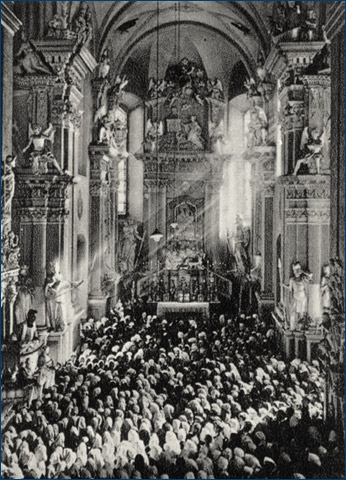


There was never a shortage of pilgrims during the Šilinės indulgence feast. They came from various parts of Lithuania. Among them were the blind, the deaf, the mute, the lame, and those suffering from other illnesses. Pilgrims walked the Stations of the Cross, prayed before the grace-filled image of the Mother of God, and sought God’s help. Šiluva was also known for beggars, who sought to attract the attention of pilgrims with their poor appearance, hymns, and lamentations.
The Soviet period
During the Soviet period, Šiluva—long renowned throughout all times—was deliberately neglected and diminished by the authorities. In an effort to drive out the spirit of devotion, a monument “to those from Šiluva who died for Soviet rule” was erected in the town square opposite the church, replacing the statue of Mary.
The Soviet authorities made every effort to disperse or at least intimidate the pilgrims traveling to the indulgence feast. From the 1960s onward, the militia was used to obstruct their arrival—some drivers had their licenses confiscated, passengers were forced to disembark, and similar measures were taken. Roads and even side paths leading to the town were blocked. In 1979, an outbreak of swine fever was even declared in order to prevent pilgrims from coming.
However, on the last Sunday of August, young people—especially members of the Friends of the Eucharist—would still travel in procession from Tytuvėnai to Šiluva. The Chronicle of the Catholic Church in Lithuania records the third march to Šiluva, organized by the Friends of the Eucharist on 21 August 1977:
“The militia and security officers were guarding the forest where we had been gathering for the common journey since 5 a.m. Militia vehicles stood watch at every road leading to Šiluva and suspiciously checked passing cars, forcing passengers to disembark by the roadside and confiscating some drivers’ licenses. The militia recorded the license plate numbers of private cars and checked the documents of their owners. Many had to hurry a considerable distance on foot to reach the agreed meeting place. But the people, filled with enthusiasm and courage, did not lose heart. At the meeting place, in the small forest, a cross was erected, which the youth adorned with a wreath of Lithuanian rue, and, gathering around it in a circle, they loudly prayed the Rosary.”

That people did not yield to intimidation is also evident in another article of the Chronicle of the Catholic Church in Lithuania (LKBK, No. 12, 1974)
“At the beginning of September, during the Šilinės indulgence feast, crowds of thousands of people streamed to Šiluva. On Sundays, cars could not fit into the town, and traffic inspectors directed them to park in the fields. The inspectors demonstratively recorded the license plate numbers of the vehicles. During the Šilinės indulgence feast, around 50,000 Holy Communions were distributed each year.”
The Chronicle provides statistical data on the number of participants in the processions to Šiluva: in 1975, 500–600 people took part; in 1976, 600–700; and in 1977, 800–1,000. Considering how the Soviet authorities sought to disperse any religious gathering, these processions indeed drew large numbers of people who, overcoming fear and various obstacles, chose to participate.
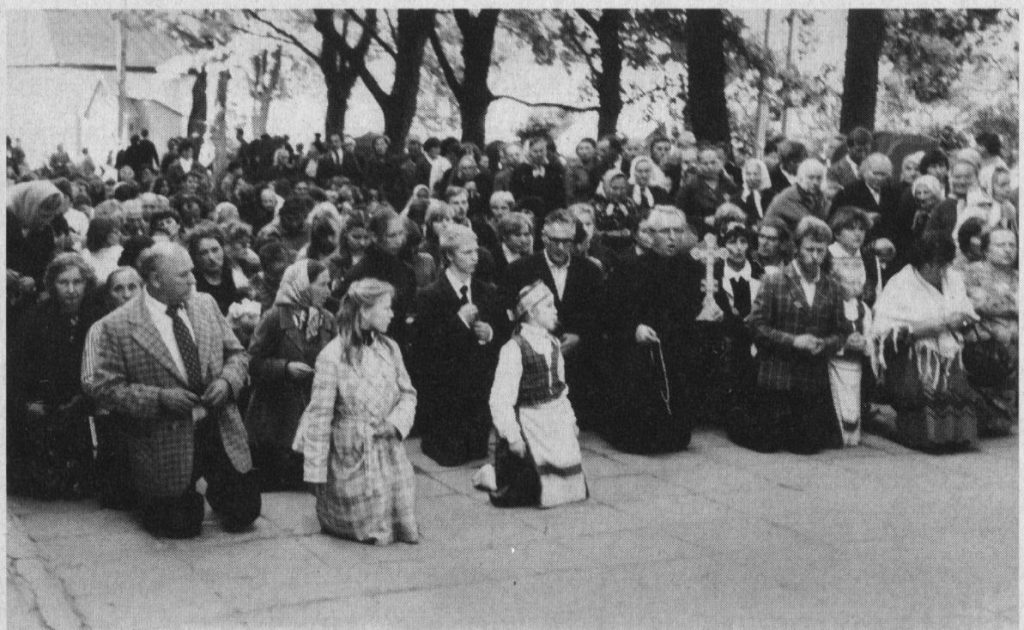

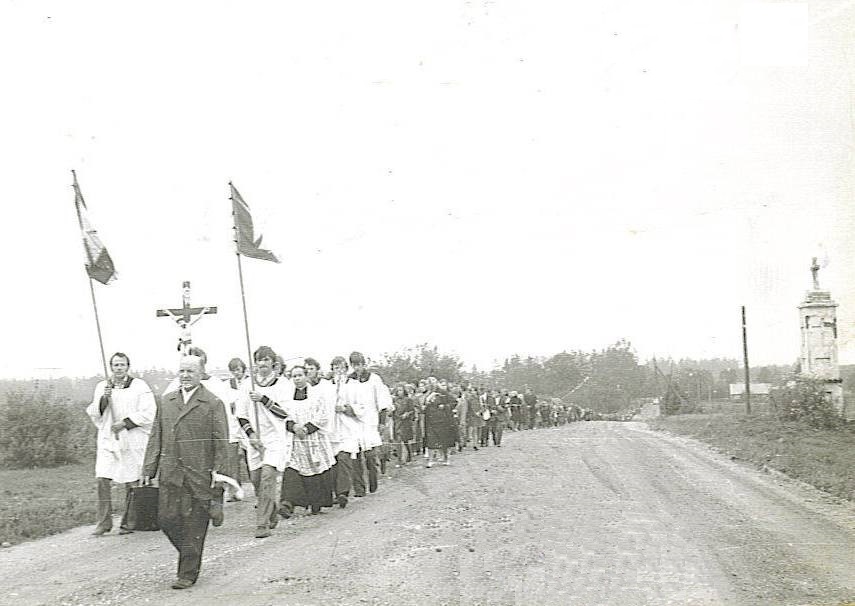

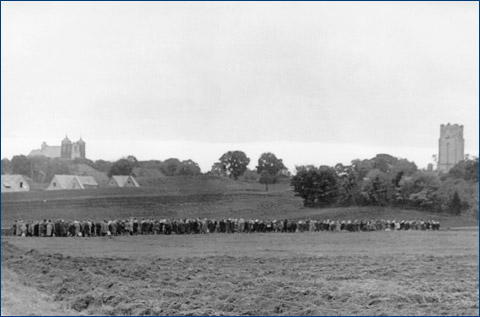
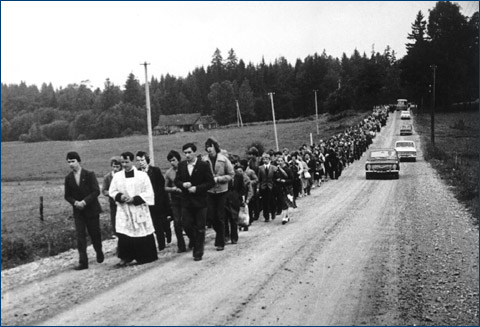
Organizers of devotional journeys were especially persecuted. Sister Gema Stanelytė of the Congregation of Eucharistic Jesus and Vytautas Vaičiūnas were sentenced to three years of imprisonment for organizing processions to Šiluva.
However, despite all the efforts of the occupying authorities, Šiluva remained a witness to the spiritual strength of the Church—a place where the Lord is worshipped and where strength for both soul and body is drawn.
In exile
Lithuanians living in the free world also did not forget the Šiluva indulgence feast.
The first Šilinės celebration took place on 8 September 1947 in Altötting, Bavaria; another was held on 16 November 1947 in Absam, Tyrol, Austria.
The Šilinės indulgence feast was celebrated in Lithuanian parishes in Argentina, Uruguay, and the United States. From 1959 onward, Lithuanian pilgrim processions were also held in Chicago and Marianapolis. From 1957, the Federation of American Lithuanian Affairs Councils, with the support of American bishops, organized a Day of Prayer in Lithuanian parishes on the occasion of Šilinės—a spiritual pilgrimage to Šiluva.
Independent Lithuania
After Lithuania regained independence, the Nativity of the Blessed Virgin Mary indulgence feast in Šiluva became one of the most important events in the religious life of Lithuania. It was actively promoted, and booklets and brochures about Šiluva were published.
On 8 September 1991, in Šiluva, giving thanks to God for the gift of freedom and in the presence of all the bishops of Lithuania, Cardinal Vincentas Sladkevičius consecrated Lithuania to the protection of the Blessed Virgin Mary. The act of consecration is preserved here. This act signified that the hopes and expectations of independence were entrusted into the hands of the Mother of God of Šiluva, who had continually accompanied the nation on its path to freedom through her intercession.
The Soviet occupation did not succeed in uprooting the tradition of pilgrimages to Šiluva. On the contrary, the processions—banned, obstructed, and persecuted by the authorities—strengthened people’s devotion, especially among the youth, fostering unity and determination to remain faithful to their beliefs.
Organized pilgrimages to the Šiluva indulgence feast continued, not only from nearby parishes but also from Kaunas. Up to 100,000 pilgrims would gather for the Šiluva indulgence feast. A committee for organizing pilgrim journeys was even established in Kaunas.
A new impetus, filled with hope in turning to the Mother of God of Šiluva, was given to the Lithuanian nation by the visit of Pope John Paul II to Šiluva on 7 September 1993.
For the people of Lithuania building an independent life—and amid the conditions of freedom that brought their own challenges and difficulties—Šiluva has remained a visited and cherished modern pilgrimage shrine.
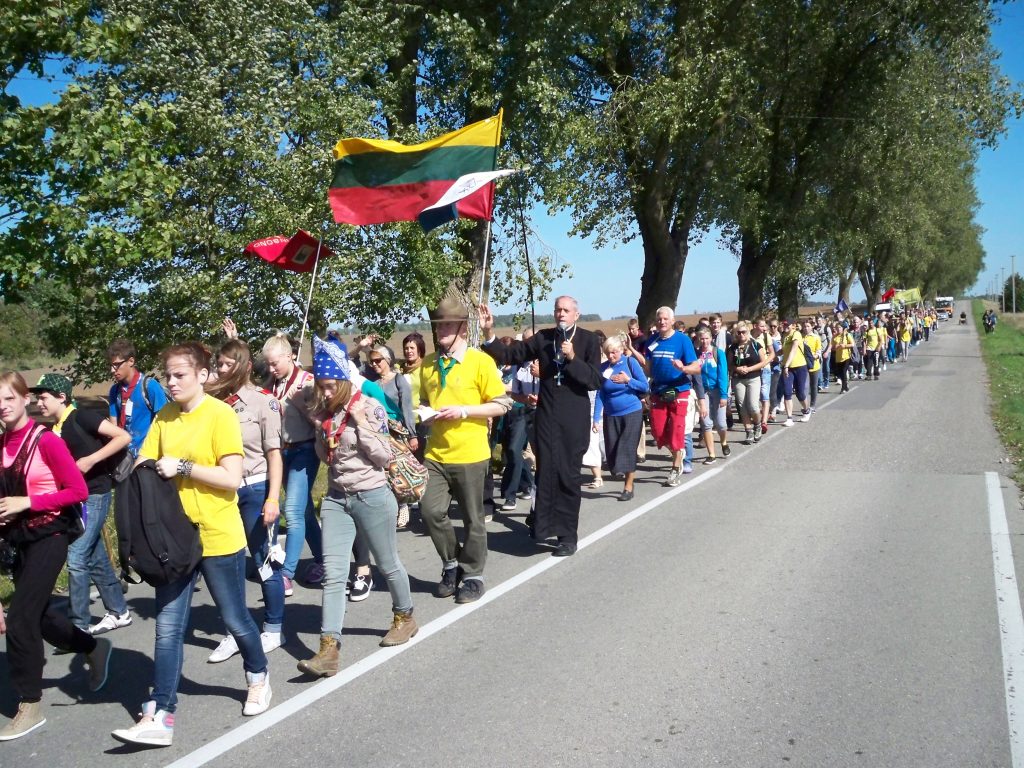
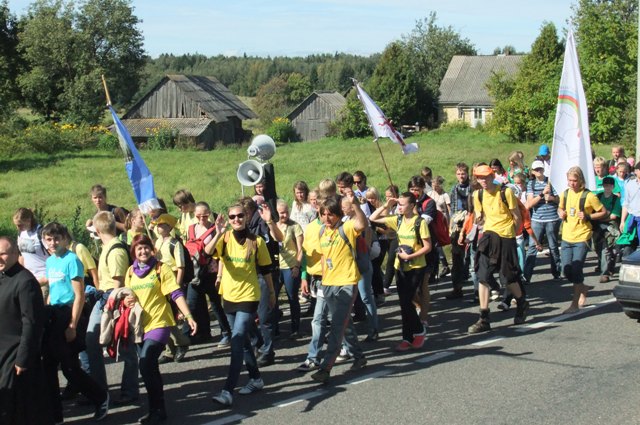
Each year at the beginning of September, pilgrims from all over Lithuania, together with visitors from abroad, gather in great numbers in Šiluva to celebrate the Šilinės indulgence feast, which lasts for a full octave. Its tradition—restricted in various ways during all periods of occupation—has remained alive: it can be said that the great Nativity of the Blessed Virgin Mary indulgence feast in Šiluva has been celebrated for nearly five hundred years.