
The Reformation reaches Šiluva
In the 16th century, the wave of the Reformation reached Šiluva. Around 1532, its owner, Jonas Zaviša, together with other nobles, converted to the Reformed faith. About one and a half kilometres from the town, he built a Protestant chapel, which was later renovated or expanded. In 1555, Jonas Zaviša transferred Šiluva to his brother Merkelis, who is regarded as the founder of the Calvinist parish in Šiluva.
For a time, both an Evangelical Reformed chapel and a Catholic church functioned in Šiluva. However, in 1560, when Šiluva came under the control of Merkelis Zaviša’s cousin, Merkelis Šemeta—an especially zealous promoter of the Reformation—the property of the Catholic church in Šiluva was confiscated, and the church itself was closed.
The new Reformed centre established on the estate’s land gradually came to be known as Zbarai., nes zbarais The term zbor (in Polish) was used to refer to Calvinist communities and their houses of worship. The town of Šiluva began to decline into a village, while the locality of Zbarai—referred to in official documents as Šiluva (Szydlowa)—was becoming a cultural centre for the entire Calvinist region of Samogitia. The Catholic population was increasingly pressured to convert to the new confession.
Around 1569, the last parish priest of Šiluva, Jonas Holubka—perhaps foreseeing the destruction of the Catholic church—gathered the remaining church valuables and documents and, placing them in an iron-bound chest, buried them near the former church.
The activity of the Calvinist Sofija Vnučkienė
The resourceful and particularly devoted Calvinist Sofija Vnučkienė, the widow of Morkus Vnučka, in 1591 arranged to purchase the confiscated parish lands from the then rulers of Šiluva and transferred them to the Calvinist community.
The purchase agreement was signed on 1 September 1591 and stated that the Šiluva estate was being transferred “together with the town and its church dependents, with the rectory and the Pašakarnis manor belonging to the Šiluva parish.” For this, she paid 9,000 Polish złotys to Merkelis Zaviša.
Three months later (on 4 January 1592), she “transferred, donated, and granted Šiluva with its estate, town, and the Pašakarnis manor belonging to the Šiluva property, together with the church and church buildings, as well as all the land and its dependents” to the Calvinists of Šiluva.
In one of her writings, S. Vnučkienė states: “With great dedication I took care to redeem this place, (for) some decades earlier it had been cleansed of Roman idolatry and adorned (by the Reformed).” However The enemies of God took particular care that it should return to its former state.” The greatest threat was the owner’s own son, Andrius Zaviša, who had already returned to Catholicism. His father was already old and could die at any moment (in fact, he died a year later), and once the son took over, he would undoubtedly have restored Šiluva to its “former state.”
According to her intentions, this could not be allowed, so she devoted all her efforts to making Šiluva a centre of Calvinism. More than other Reformed nobles, she sought not to leave the people in “idolatry”—she ensured that Calvinism was proclaimed in the Lithuanian language and published the first Calvinist Gospels in Lithuanian. She also made significant efforts in establishing a Calvinist parish school. “Children of the common people” were admitted there—even if they were not Evangelicals—but in return they were required to attend Calvinist services. In 1592, a Calvinist seminary was established in Zbarai—the only school in Lithuania dedicated to training their clergy and teachers.
After several years, a masonry church was built in place of the wooden Calvinist chapel that had stood there (construction began in 1593 and was completed in 1595). It is believed that bricks and stones from the former Catholic church were used for this new building, and a bell from the Catholic church was also transferred to the new Calvinist church, where it rang for many years, bearing the inscription: O florens Rosa, Mater Dei speciosa! (“O blooming rose, pure Mother of God!”). The golden and silver vessels of the Catholic church and other liturgical items were destroyed, as well as church vestments and furnishings. With the demolition of the Catholic church, the “cleansing” of Šiluva from “Roman idolatry” was meant to be completed.
The recovery of the Šiluva church
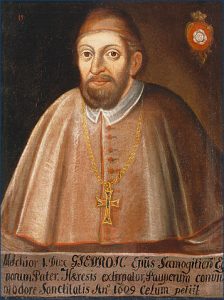
It is true that the rise of Calvinism was opposed by the Bishop of Samogitia, Merkelis Giedraitis, who initiated legal cases to recover the lost churches, as the Third Statute of Lithuania (1588) recognized the right of Catholics to reclaim confiscated property.
Around 1606, the bishop entrusted the work he had begun to a devoted priest—his friend and collaborator, Jonas Smolka-Kazakevičius. He showed great courage by initiating the case of Kelmė and, on 11 August 1609, succeeded in restoring the church of Kelmė to the Catholics. The case was difficult, as the property documents had been lost; however, it was remembered to whom they had been entrusted, and the bishop together with his curia were aware of the church’s property. This, however, was only preparation for the case of Šiluva, since no information at all was available about the founding documents of Šiluva.
It was possible to rely only on Vnučkienė’s writings, which stated that this place had long been reformed and cleansed of “Roman idolatry,” and on that basis to initiate the case; however, it was difficult to define the claim. Without the necessary documents, there was no hope of winning the case.
At this point, the Blessed Virgin Mary herself enters this difficult and complex history. After her apparition (which took place in 1608), the church’s foundation documents were unexpectedly discovered in 1612. Once they were found, the case continued without interruption from 1612 and was won after ten years. Written accounts of Šiluva’s history state that “the case lasted more than 15 years,” which suggests that the first unsuccessful proceedings may have begun in 1607 or 1608. The case was finally concluded on 22 July 1622 by the decision of the Vilnius Tribunal.
Further disputes
However, the Calvinists did not rush to implement the decision. The Catholics then attempted to take possession of the lands awarded to them on their own, but encountered resistance from the Calvinists. A month after the tribunal’s ruling, clashes broke out between the two sides in the church gardens.
Another widely known uprising occurred when the new parish priest of Šiluva, Sviekauskas, attempted on his own initiative to reclaim a disputed plot of land from the local Calvinists. This land was located by a large stone, near the newly rebuilt chapel of Bishop A. Sapiega. The Catholic cemetery was also situated there. Having conceived this plan, Canon Sviekauskas sent his vicar, Fr. Sierniauskas, together with Mr. Simanavičius and a group of men to take back the mentioned land.
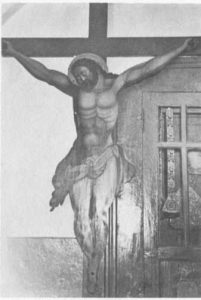
At that time, the Calvinist pastor was Chelkauskas. The new pastor gathered people, armed them, and ordered them to drive away the men of Sviekauskas. When the two sides met, they began to argue, then to fight with fists and sticks, and finally, as they approached the chapel, they started shooting. One bullet struck and wounded Fr. Sierniauskas, while another pierced the image of the Crucified hanging in the chapel, which had been donated by Bishop Sapiega. This took place at the end of 1668 or the beginning of 1669.
In Šiluva, this was not the first such incident—the struggle against crosses as signs of “Roman idolatry” also took place elsewhere in Lithuania. A well-known case occurred in 1640 in Vilnius, in which Calvinists were accused of shooting at sacred images in St. Michael’s Church and at a cross on top of the church.
The case in the Parliament of the Republic of Lithuania
Bishop Kazimieras Pacas, having investigated the incident and gathered evidence, decided to bring a case against the Calvinists of Šiluva before the State Seimas itself. The conduct of the Calvinists of Šiluva, as it was presented to the Seimas, provoked considerable outrage among both the assembled nobility and the new king, Kaributas Wiśniowiecki. Such behavior, violating the majesty of God, was strictly punished under the laws of the state.
The following penalties were imposed on the Calvinists of Šiluva: their community was dissolved, their lands were confiscated, and three “zbor members” along with a preacher were sentenced to death. The royal decree of the Seimas was signed on 6 November 1669 in Kraków.
Efforts at reconciliation
Bishop Kazimieras Pacas, having investigated the incident and gathered evidence, decided to bring a case against the Calvinists of Šiluva before the State Seimas itself. The conduct of the Calvinists of Šiluva, as it was presented to the Seimas, provoked considerable outrage among both the assembled nobility and the new king, Kaributas Wiśniowiecki. Such behavior, violating the majesty of God, was strictly punished under the laws of the state.
The following penalties were imposed on the Calvinists of Šiluva: their community was dissolved, their lands were confiscated, and three “zbor members” along with a preacher were sentenced to death. The royal decree of the Seimas was signed on 6 November 1669 in Kraków.
The Reformed, whose influence was still quite strong, mobilized in an effort to have the decision changed and mitigated. However, these efforts proved fruitless. With no hope of altering the ruling regarding Šiluva, the Reformed began to seek another solution. For this purpose, meetings were convened in Kėdainiai in 1670 and an assembly in Vilnius in 1671. In Vilnius gathered the elders of the Calvinist communities, a considerable number of preachers, and the patrons of the Šiluva community. The assembly resolved to seek an “amicable settlement” and appealed to the administrator of Šiluva, Jonas Merkelis Bilėnas-Bilevičius, asking him to mediate between the Calvinists and the Bishop of Samogitia.
Bilevičius agreed, and negotiations began. Eventually, it was agreed that Jonas Merkelis Bilevičius, in the presence of the patrons of Šiluva, would pay 12,000 złotys to Bishop Kazimieras Pacas and the Chapter of Samogitia. In return, the Calvinist community of Šiluva transferred to him the Šiluva estate, the Pašakarnis manor, the village of Nanišai, and the Rugieniškiai holding, as well as the town of Šiluva with 21 peasant families and 11 villages with their inhabitants.
The Calvinist community retained only the church with its rectory, the enclosed plot of land around the church, the school, and the pastures belonging to the rectory and its dependents. Bilevičius was also asked to protect and defend this remaining Calvinist property. The transfer of Šiluva to Bilevičius was signed on 16 March 1672 in Šiluva itself. By this agreement, the Calvinist lands of Šiluva were saved from confiscation, and three “zbor members” along with a preacher were spared the death penalty.
Bishop Kazimieras Pacas allocated the funds received from the Calvinists to the church of Šiluva, stipulating that Holy Mass be celebrated every Friday in honor of the Cross at the chapel by the image of the Crucified, accompanied by music. At the same time, in 1677, he instituted the Feast of the Exaltation of the Cross along with indulgences.
